

When we think about workplace safety, physical hazards are often the first things that come to mind. But workplace risk isn’t always visible.
Psychosocial hazards can be present in workplaces in many ways, including things like excessive job demands, poor support, bullying, harassment, violence and poor workplace relationships. These can affect a person’s psychological health and can also contribute to physical harm.
The Workers Compensation data shows why this deserves attention.
Mental health claims are increasing
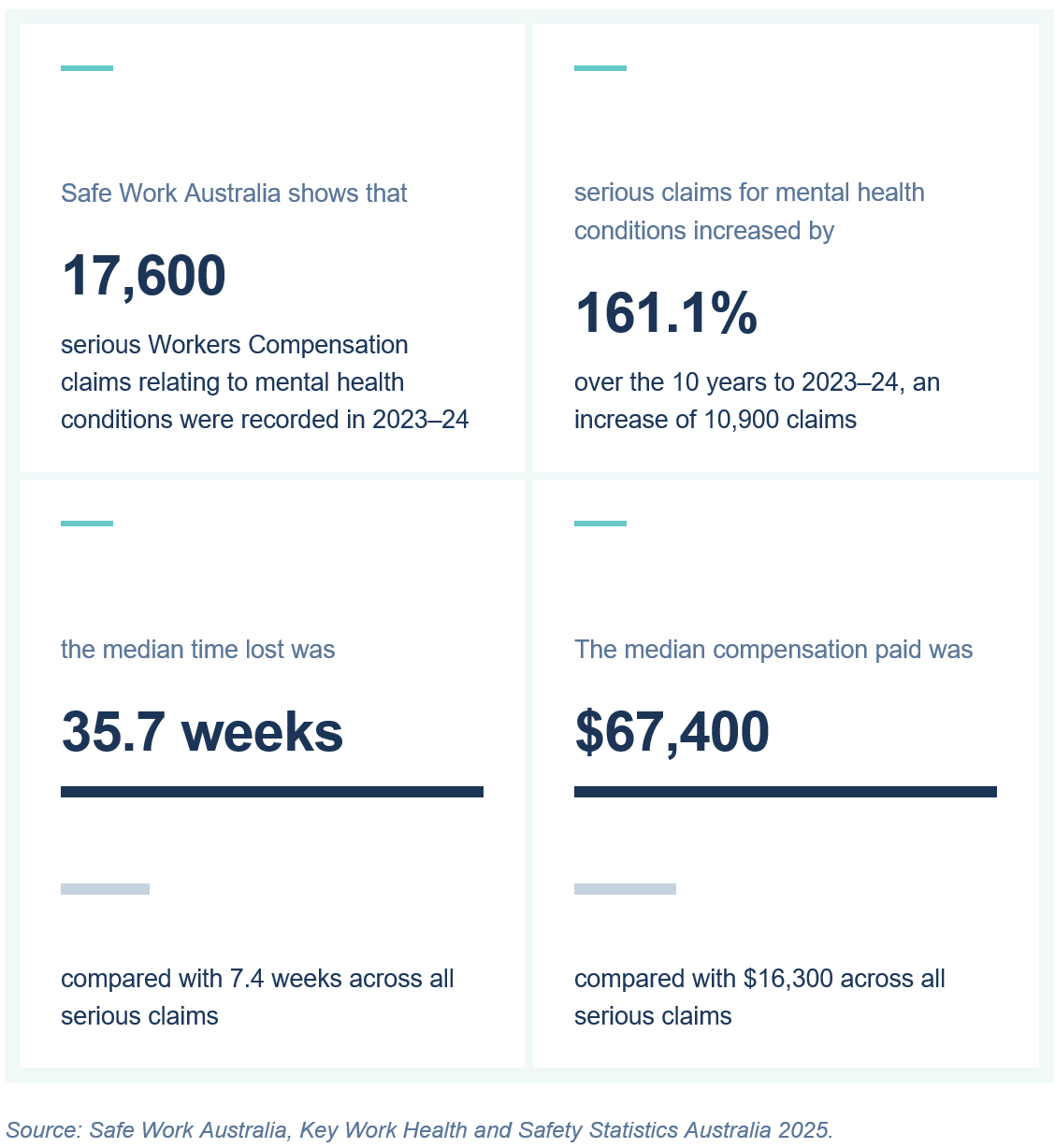
The latest national data from Safe Work Australia shows that 17,600 serious Workers Compensation claims relating to mental health conditions were recorded in 2023–24. These represented 12% of all serious claims, up 14.7% on the previous year.
Looking at the longer-term trend, serious claims for mental health conditions increased by 161.1% over the 10 years to 2023–24, an increase of 10,900 claims.
The impact of these claims can also be significant.
Mental health conditions are also one of the costliest forms of workplace injury. They lead to significantly more time off work and higher compensation paid when compared to other injuries and diseases. For serious mental health claims in 2023–24, the median time lost was 35.7 weeks, compared with 7.4 weeks across all serious claims. The median compensation paid was $67,400, compared with $16,300 across all serious claims.
That means psychological injury isn’t simply a wellbeing issue. For employers, it can also become a significant people, operational and Workers Compensation risk.
Prevention starts with understanding the risk
Under the model Work Health and Safety (WHS) laws, businesses must eliminate psychosocial risks where reasonably practicable, or minimise them where elimination isn’t reasonably practicable. This includes identifying foreseeable hazards, implementing controls, and reviewing whether those controls are effective.
Importantly, psychosocial risks aren’t limited to workplace culture. They can arise from the design and management of work, the working environment and workplace interactions.
For employers, this means looking beyond offering an Employee Assistance Program or wellbeing initiatives. These can provide valuable support, but Safe Work Australia notes that they do not replace the need to identify and control the underlying psychosocial risks.
What can employers do?
Managing psychological safety starts with understanding where the risks are within your business. Consider:
✓ Are workloads realistic? Excessive demands, long hours and insufficient resources can contribute to psychosocial risk.
✓ Do workers have adequate support and control? Clear roles, appropriate supervision, consultation and opportunities for workers to have input can help reduce risk.
✓ Are harmful behaviours being addressed? Bullying, harassment, violence, aggression and poor workplace relationships can all contribute to psychological harm.
✓ Are you responding to warning signs? Changes in absenteeism, staff turnover, complaints, workplace incidents or claims may provide valuable insight into emerging risks.
For businesses, the connection between WHS, people risk and Workers Compensation is becoming increasingly important. A proactive approach can help reduce the likelihood of injury, support workers when issues arise and contribute to better claims and return-to-work outcomes.
Source: NIH Insights – Beyond the Policy
Bailey Ives Dip.Finserv.(I.B), JP
Account Manager Network Insurance House
P: 1300 655 037 m: 0447 027 616
e: bailey.ives@nih.com.au
